Asterophora mirabilis
(T.W. May) Redhead & Seifert 2001
Description:
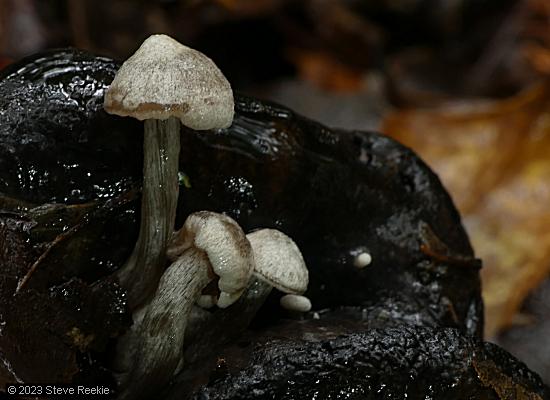
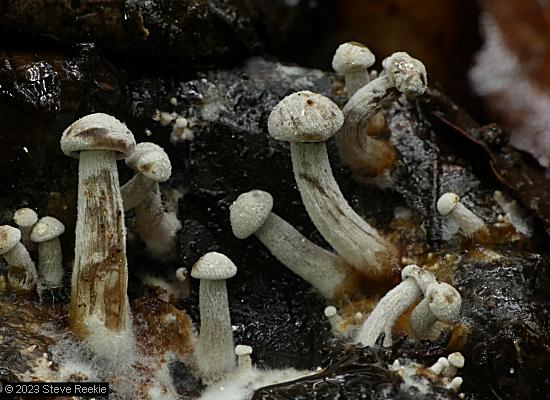
A striking parasitic agaric notable for growth on decaying Russula or Lactarius fruitbodies. It is the most morphologically developed species in the genus, forming substantial basidiomes rather than the powdery, reduced forms typical of A. parasitica and A. lycoperdoides.

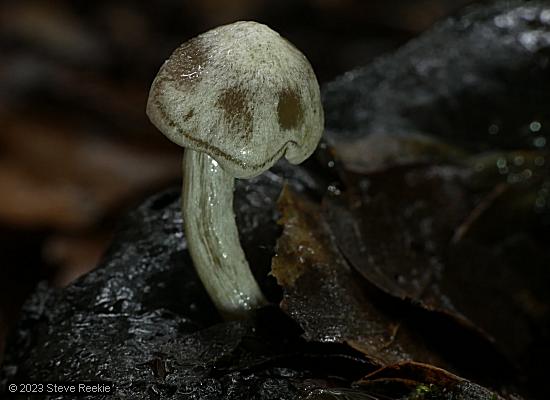
Pileus: 10-40 mm diameter; occasionally larger in well-developed specimens. Convex to plane. Dry, finely fibrillose to velvety, grey-brown, fawn, or pale umber, often darker centrally. The margin is enrolled, even.
Lamellae: White to pale cream. Thick, broad, and well-formed, unusually developed for the genus. Spacing moderately close; lamellulae present.
Stipe: Short, stout, often eccentric or lateral, depending on how it emerges from the host fruit body. Pale grey-brown to cream. Firm compared with other Asterophora species.
Context: Soft, pale, thin.
Odour/tast: Not distinctive

Common name: Grey Jockey
Habitat: Nothofagus forest
Substrate: Growing on Russula
Distribution: South Island
Season: Autumn
Biostatus: Indigenous
Edible: No
Spore print: Brown
Macro images:
Asterophora mirabilis
Scale bar
Scale= 15 mm.
 
Asterophora mirabilis
Scale bar
Scale= 13 mm.
 
Asterophora mirabilis
Scale= 8.5 mm.
 
The Hidden Forest
Forest Fungi