Hygrocybe astatogala
Heim ex Heim
Description:
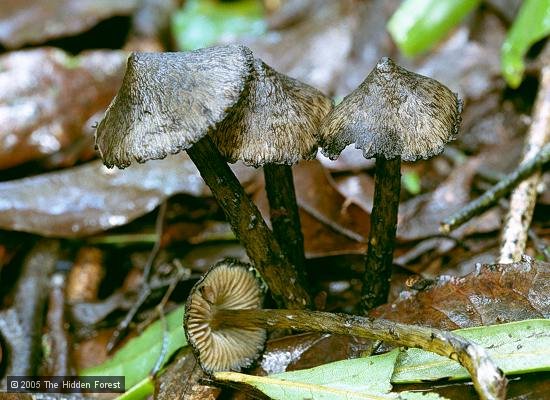
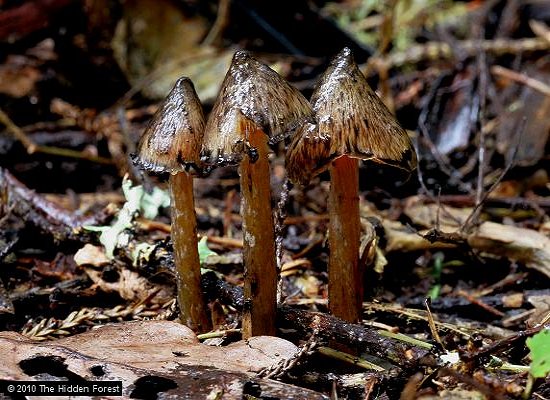
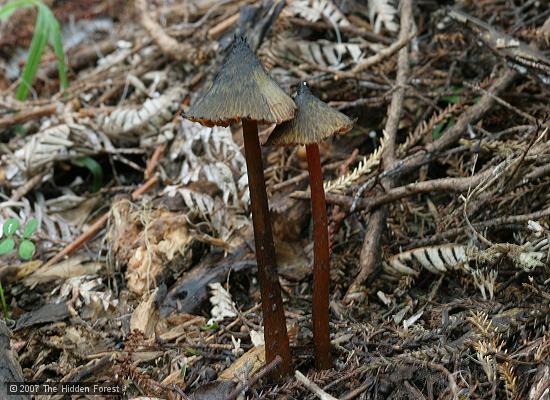
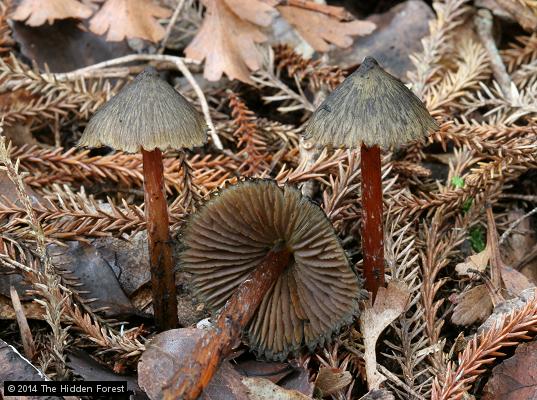
This distinctive blackening waxgill is characterised by its yellow to orange conic cap that rapidly becomes black when bruised or with age, and by its dense covering of black, hairy fibrils on both cap and stipe. The lamellae undergo the same transformation, shifting from deep orange to grey-yellow to black.

Pileus: 13-35 mm diam. Obtusely to sharply conic when young, becoming conico‑campanulate. Radially splitting with age. Yellowish to orange when young, quickly blackening when bruised or old. Densely covered with black, hairy fibrils. Dry, estriate.
Lamellae: Nearly free to adnexed. Deep orange when young to grey-yellow (Tan) toblack. Gill‑edge concolorous, eroded, and does not reach the pileus margin.
Stipe: 60-130 x 3-6 mm. Cylindric, equal, occasionally attenuated toward apex. Strict, brittle, fistulose. Yellowish to light orange, becoming black like the pileus. Densely covered with hairy to scaly black fibrils. Dry; solitary.
Context: Yellow, turning black.
Odour/tast: not distinctive.

Common name: None
Habitat: Lowland podocarp-broadleaf forest
Substrate: Saprobic, on soil amidst leaf litter
Distribution: New Zealand wide
Season: Autumn
Biostatus: Uncertain
Edible: No
Spore print: White
Macro images:
Hygrocybe astatogala
Scale bar
Scale= 8.7 mm.
 
Hygrocybe astatogala
Scale bar
Scale= 12 mm.
 
Hygrocybe astatogala
Scale bar
Scale= 12 mm.
 
Hygrocybe astatogala
Scale bar
Scale= 12 mm.
Notice the orange gills this is one of the verations found with this fungi.
Micro images:
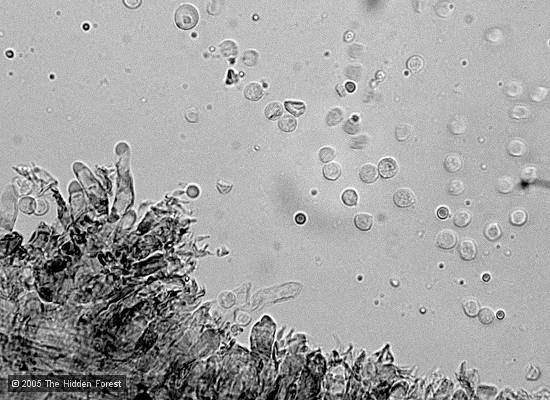
Hygrocybe astatogala
Scale bar
Magnification =400x
Spores: Notice there globose shape.
 
The Hidden Forest
Forest Fungi