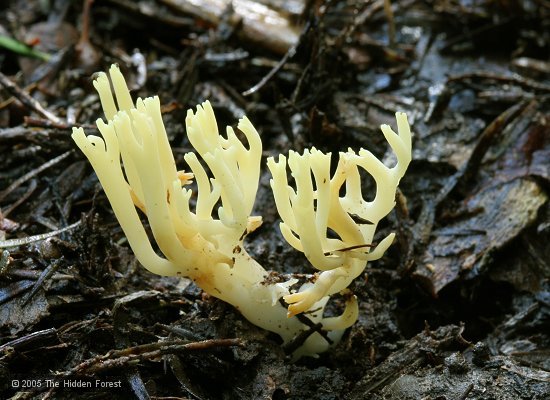
Ramaria lorithamnus
(Berk.) R.H. Petersen 1982
Description:
A yellow, tuft-forming coral fungus with straw-coloured branches and apices, the tips awl-shaped and often slightly more yellow than the branches. Branches smooth, cylindrical, vertically oriented, becoming pale yellow-buff with age and often powdery with spores

Fruitbody: Individual fruit bodies 50-90 x 30-40 mm, typically forming tufts to 8 cm diameter. Apices yellow, concolourous with or slightly brighter than the branches, sometimes browning at the extreme tips with age or drying. Tips awl-shaped, narrow-rounded, and single, dichotomous, or trichotomous; surface dry.
Branches: Wholly yellow, becoming pale yellowish-buff with age. Cylindrical, smooth, though older branches often appear powdery with spores. Orientation mostly vertical, though lower branches may be horizontal. Axils rounded, sometimes with a short furrow extending downward.
Stipe: 10-25 x 2-4 mm, white, smooth to finely velvety or woolly in patches. No aborted branchlets. Rhizomorphs absent or poorly developed.
Flesh: White, pliable rather than brittle. Branches and stipe slowly stain brownish when bruised.
Odour/taste: Odour None when fresh, but develops a strong broad-bean odour when enclosed in a container. Taste None.

Common name: None
Habitat: Myrtaceae forest
Substrate: Soil
Distribution: New Zealand wide
Season: Autumn to early winter
Biostatus: Indigenous, non-endemic
Edible: No
Spore print: Tan
Macro images:
Ramaria lorithamnus
Scale bar
PDD 83016    Scale= 2.5 mm.
 
The Hidden Forest
Forest Fungi