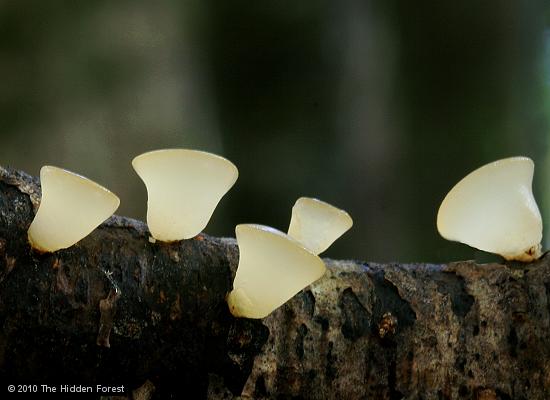
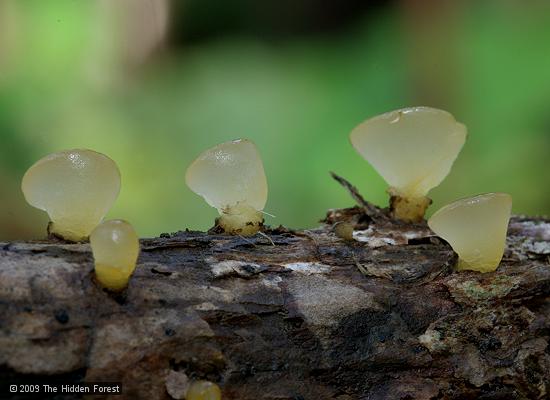
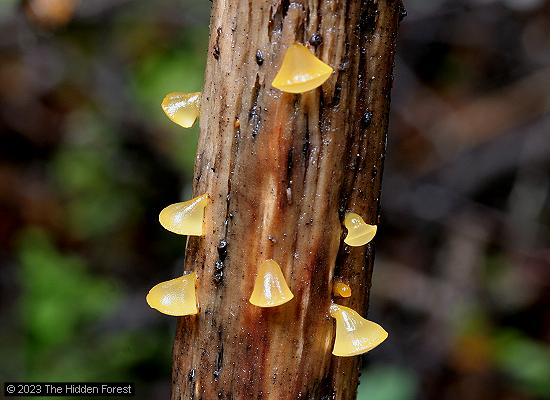
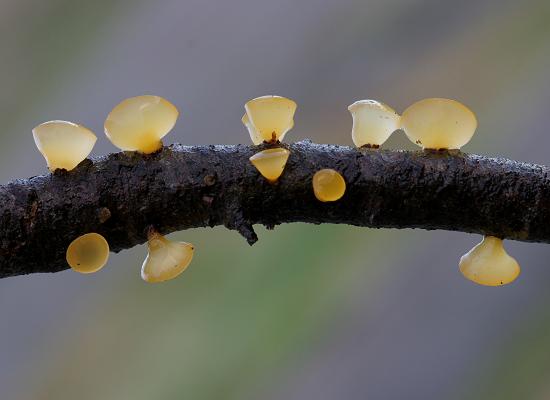
Heterotextus miltinus
(Berk.) McNabb 1965
Description:
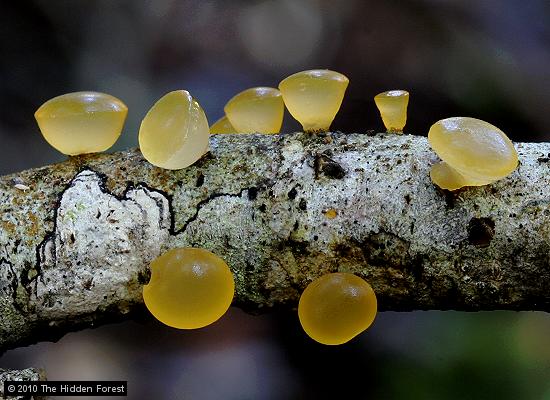
Basidiocarps: Gregarious or scattered, forming patches on well‑rotted wood. Stipitate and pileate; overall height to ~9 mm. Pileus cupulate to flattened‑discoid, often irregularly undulate at the margin. 4-10 (-15) mm diameter; older fruitbodies often collapse onto the substrate. Surface externally roughened, sometimes faintly ribbed. Consistency gelatinous, becoming dull orange‑red and leathery when dry.
Growth Habit: Occurs scattered or in loose clusters, often forming small colonies on decayed wood. Fruitbodies frequently tilted or distorted by substrate irregularities. In age, the cup collapses, leaving a flattened, gelatinous patch.
Colour: Highly variable: Pallid cream, orange‑yellow, or orange‑red when fresh. Dries to dull orange or orange‑red. Colour variation is not taxonomically significant; all forms belong to the same species.
Substrate: On angiosperm and gymnosperm wood. In New Zealand, common on deeply decayed broadleaf logs and branches in damp forest.

Common name: Golden Jelly Bells
Habitat: Nothofagus and Myrtaceae forests.
Substrate: Decaying wood
Distribution: New Zealand
Season: Autumn
Biostatus: Indigenous, non-endemic
Edible: Unknown; not recomended
Spore print: White
Macro images:
Heterotextus miltinus
Scale bar
Scale= 4 mm.
 
Heterotextus miltinus
Scale bar
Scale= 2.4 mm.
 
Heterotextus miltinus
Scale bar
Scale= 2.4 mm.
 
Heterotextus miltinus
Scale bar
Scale= 2 mm.
 
Heterotextus miltinus
Scale bar
Scale= 4 mm.
 
Heterotextus miltinus
Scale bar
Scale= 1 mm.
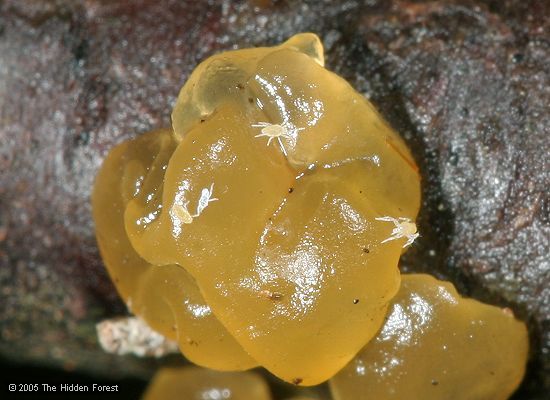
I noticed after I had taken this photo that it had 3 mites consuming it for tea beside the one on the left is the skin of one after it been shead as it grows
 
 
The Hidden Forest
Forest Fungi