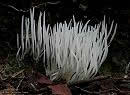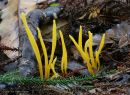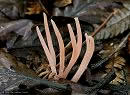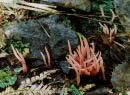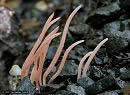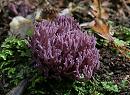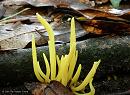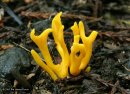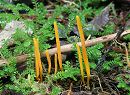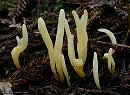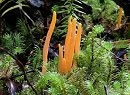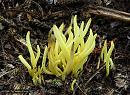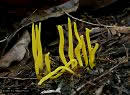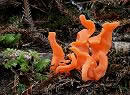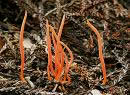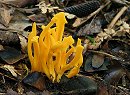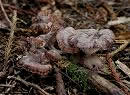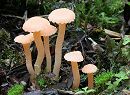
Clavariaceae are a family of simple, erect, club- or coral-shaped basidiomycetes, producing unbranched or sparsely branched fruit bodies arising from soil, litter, or moss. Colours range from white, cream, and yellow to bright orange or purple, depending on genus. Fruitbodies are typically smooth, cylindrical, or flattened, lacking distinct caps or gills. The family represents the classic “club fungi” in the field, distinct from the more elaborately branched Ramariaceae and the jellylike Dacrymycetaceae. Clavariaceae was once only known to include clavarioid fungi, but recent phylogenetic studies have moved three agaricoid genera into this family. These are Camarophyllopsis, Hodophilus and Lamelloclavaria.
Clavaria comprises simple, erect, unbranched club-shaped basidiomycetes arising from soil, moss, or forest litter. Fruitbodies are typically cylindrical, flattened, or slightly compressed, with a smooth outer surface and no distinct cap, gills, or pores. Colours range from white and cream to yellow, purple, or pale brown, depending on species.
The entire outer surface is fertile, with the hymenium covering the club from base to tip.
Clavulinopsis comprises slender, erect, unbranched club-shaped basidiomycetes, typically brightly coloured in shades of yellow, orange, red, or pink, though some species are pale or white. Fruitbodies are smooth, cylindrical, sometimes slightly flattened or tapered, arising from soil, moss, or forest litter.
The entire outer surface is fertile, with no cap, gills, or pores.
This genus represents the classic “bright clubs” of forest floors and grasslands.
Hodophilus is distinguished from other genera in this family by its small agaricoid fruiting body, that has a hygrophanous cap Hodophilus comprises small to medium-sized agarics with dry, matt, often pale or dull-coloured caps, widely spaced decurrent gills, and a distinctly fibrous or cartilaginous stipe. Colours range from whitish, buff, and grey to pale ochre or brownish, rarely vivid. Caps are typically smooth, dry, and unpolished, lacking viscid or waxy surfaces.
Gills are broadly to strongly decurrent, often distant, and usually pale.
The overall habit is subdued which is opposite of the bright coloured waxcaps they are sometimes confused with.