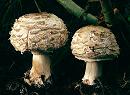
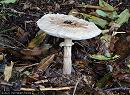
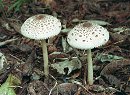
This family contains several large genera of gilled saprobic fungi, both native and introduced exotics, that grow on the ground or organic debris, such as wood chip mulch.
Recently, DNA evidence has moved a number of other families, such as Lepiotaceae, Lycoperdaceae, and also into the Agaricaceae.
The gills are free, or almost free, from the
stipe, and initially are covered by a partial
veil which breaks to leave a well defined
annulus, or ring, around the stipe. The spores are blackish, or dark brown, or pink in young specimens. Unfortunately, little research has gone into this group so many of the natives are unnamed.
This small genus consists of Coprinus comatus and several close relatives. This is all that is left in this genus after most members were moved to the Psathyrellaceae family.
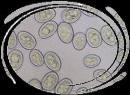
Lepiota and allied fungi are fleshy saprobic gilled fungi similar in macro-characters to the Agarics but with a white or pale spore print. Gills are free from the stem with partial veils that typically leave a ring on the stem that may be loose. The spores are smooth and dextrinoid under a microscope. Some members are good for eating while others are poisonous. Unfortunately, this group of fungi has never been studied in New Zealand, thus many are not named.
Those that are named have been introduced or are also native to Australia. It's a challenge to place them in the right genus and needs careful study of the keys.
The different genuses can be identified by:
Chlorophyllum - large, shaggy mushrooms whose stems stain orange when cut or scratched.
Leucocoprinus - Tthe smallest (<5cm across) and most delicate with a well developed ring and somewhat granular membranous scales on the cap but not truly cottony. Often with striate margins in age. Clamp conections on the hyphae
Cystolepiota - small (<5cm across) mushrooms with cottony scales (that might wear off) and a poorly developed ring. Never striate.
Leucoagaricus - with either no cap scales or regular membranous scales. Leucoagaricus is more likely to be larger then Leucocoprinus. No clamp conections on the hyphae
Except for a few introduced species, most native Leucoagaricus in New Zealand have not been named. Even though they are a common genus, they are found early in the season in large numbers. Many are quite distinctive and easily recognised, while others are not so. Separating these from the similar Leucocoprinus is not so easy. They have no cap scales or regular membranous scales, with a ring that is initially fixed (but may later be movable), and they are generally larger than Leucocoprinus.
Separating Leucocoprinus from Leucoagaricus can be very difficult. They tend to be smaller, and most are delicate, with a well-developed ring and somewhat granular membranous scales on the cap, but not truly cottony. In old age, the margins are frequently striate. Like the Leucoagaricus, only introduced species are named, while few, if any, native species are not.


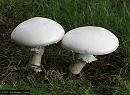 Agaricus arvensis
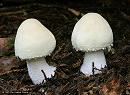 Agaricus arvensis (yellow form)
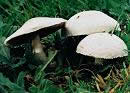 Agaricus campestris?
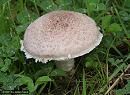 Agaricus spcies
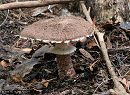 Agaricus purpureoniger
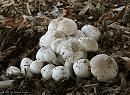 Agaricus species
 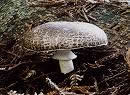 Agaricus species
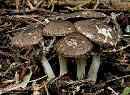 Agaricus species
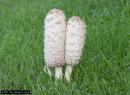 Coprinus comatus
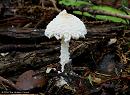 Cystolepiota petasiformis
 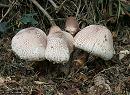 Leucoagaricus americanus
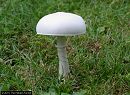 Leucoagaricus leucothites
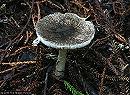 Leucoagaricus species
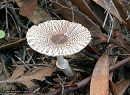 Leucoagaricus species
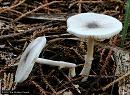 Leucoagaricus species
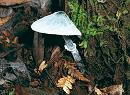 Leucoagaricus species
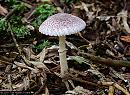 Leucoagaricus species
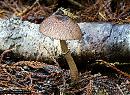 Leucoagaricus species
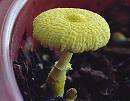 Leucocoprinus
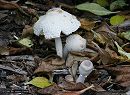 Leucocoprinus
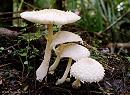 Leucocoprinus
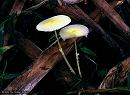 Leucocoprinus
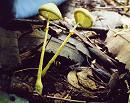 Leucocoprinus sp.
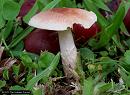 Leucocoprinus species
 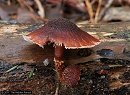 Ripartitella species